Developer merch deserves a better marketplace
Looties is where the swag of the tech ecosystem finds its second owner. This is how it started, who is building it, and what has actually shipped since April 2026.
Seen in


With




The observation
It started with a drawer, not a market study
Almost everyone in tech has the same drawer. Conference t-shirts, a hoodie from a company they left, stickers from a booth they can no longer place, a few pins, a plushie that was handed out at a keynote.
These collectibles do not disappear. They pile up. They sit at the back of a wardrobe, kept because throwing them out would feel wrong, worn twice a year, carried through three house moves before somebody finally gives up on them. Meanwhile, at every conference, someone spends an afternoon hunting for one specific t-shirt from a booth that ran out on the first morning.
The obvious answer is to resell them, and the obvious answer does not work. Search a generic resale app for a limited-edition AWS piece and it will walk you past actual ski jackets before it finds anything, because its catalogue has no idea what it is looking at. To an algorithm trained on fashion, a Kubernetes hoodie is a grey sweatshirt in size L. To the person who wants it, it is a trophy, the memory of one deployment, a badge from a conference in 2018.
That gap is the entire company. People in tech love merch: laptops carry the stack in stickers, and closets carry the rest. What was missing was never the demand. It was a catalogue that recognises what these objects are.
The founder
Where the idea came from

Quentin Sinig
Founder & CEO
3× founding go-to-market hire in open-source developer tools: Strapi, Kestra, Pruna AI. Each time from $0 to $1-5M ARR in 12 months, on products now used by hundreds of millions of people worldwide. A decade on the ground at conferences, hackathons and community events.
In his words
Looties didn't start with a market analysis. It started with years of small observations. Each time I left a software company, someone asked if they could have or buy my employee swag. At conferences, I saw people hunting for specific hoodies, while minutes later boxes of swag ended up in the trash.
People often think conference merch is just free swag. I see it differently. Every hoodie, sticker or badge tells the story of a product, a community, or a moment in tech. Our mission is to build the infrastructure around how tech culture is created, discovered, exchanged and preserved. That is how I think we strengthen it. Starting today, with a marketplace.
He writes about the thinking behind all of it on his Substack, and is on LinkedIn.
The product
A catalogue that knows what it is looking at
Looties is a peer-to-peer marketplace for tech swag: conference t-shirts, stickers, pins, caps, plushies, and the rare limited-edition pieces that never had a resale home. Swag is the unofficial language of the developer world, so the catalogue is built to speak it. Brands, conferences and editions are first-class, which means a listing can state what an object actually is instead of approximating it as clothing.
It is not another generic second-hand site with a tech filter bolted on. Put less carefully, Looties is:
- A museum of tech culture, but wearable.
- A home for the things HR forgot to collect back.
- A platform that smells like conference coffee.
- A place for everything you loved from that one booth you don't remember.
The demonstration
The thesis, made physical
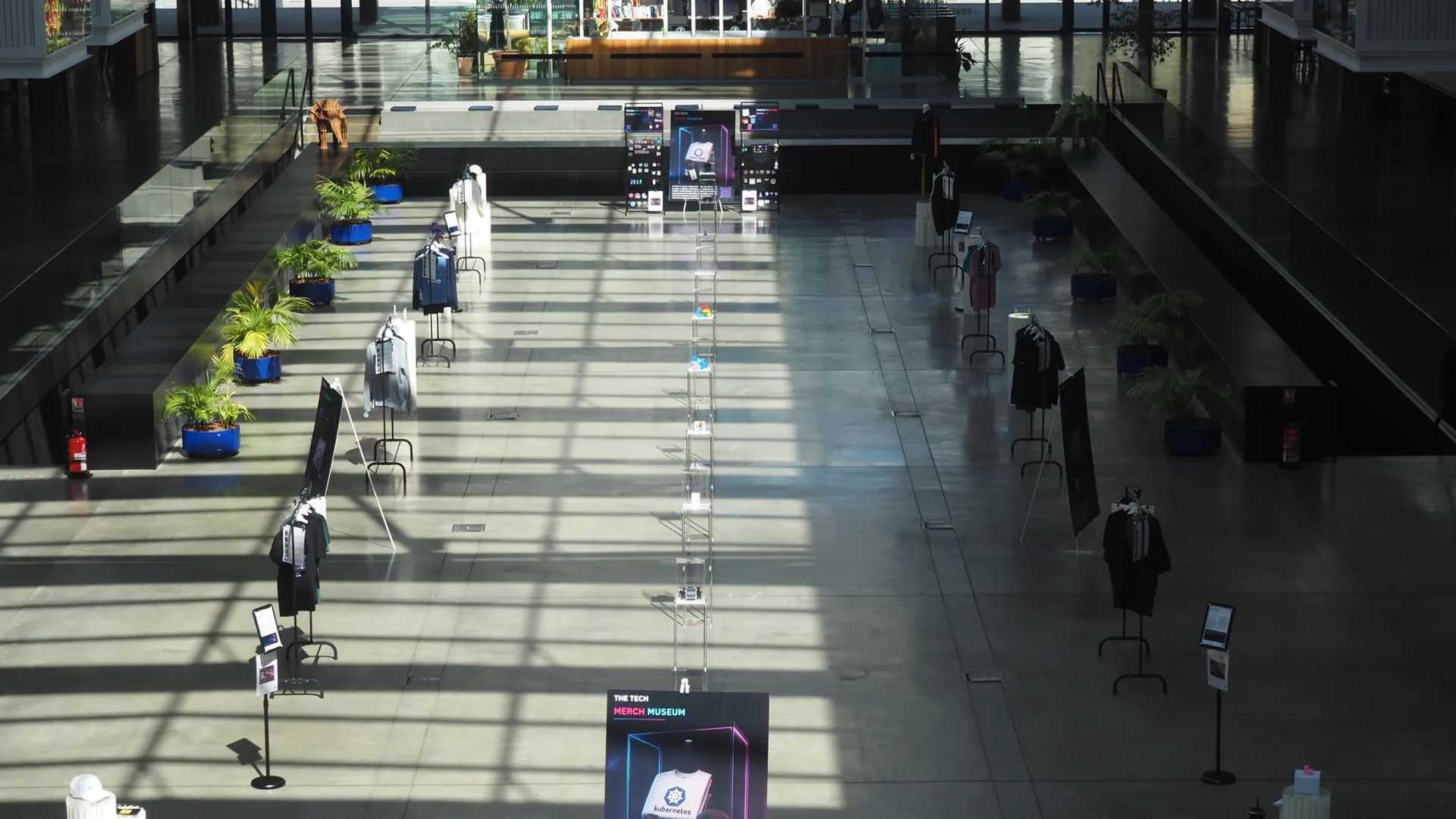
In August 2026, a hundred objects from tech culture were standing on acrylic plinths in the main hall of STATION F. The exhibition ran a full month, from July 28 to August 22: a Kubernetes sweatshirt in a display case, a Google Cloud logo on a plinth, a wall of stickers pinned by the internet. As far as anyone could tell, it was the first museum of tech culture ever staged.
It was not a marketing stunt dressed up as a museum. It was the argument itself, made physical. Give these objects a plinth, a label and a room, and people stop reading them as leftovers and start reading them as culture. More than 500 visitors walked that hall over the month and did exactly that.

“We have so much swag across the startup ecosystem that often ends up forgotten in boxes. I love the idea of giving it a second life, and of turning the best pieces into a museum celebrating tech culture.”
The press came for the objects, not for the company. Les Échos walked the hall at the end of July and reported visitors calling the pieces collector material. On August 7, BFM Business ran the exhibition on Good Morning Business. Neither piece was a product announcement, which is the point: the objects carried the story on their own.
The same year, Vogue, Forbes, The New York Times and The Wall Street Journal all wrote about tech merch becoming culture, and about the money moving through its secondary market. Looties is not the subject of those articles. It is the infrastructure their subject was missing.
Every article and the media kit live in the press room.
The method
Built in public, and checkable
Looties does not pretend to be finished. It ships, it says what changed, and it says what is coming next. All three are published, so none of it has to be taken on trust.
The changelog has carried every user-visible change since launch day, 64 of them so far, each with its ship date and none of the plumbing. The roadmap shows what sits in backlog, alpha and beta right now, with a Discord next to it so people can argue about the order. And the tooling built along the way is published too.
Latest change · Sep 19, 2026 · Connect your assistant to shop Looties
All of it happened in under five months.
- Looties launches as the first marketplace dedicated to tech merch.
- Launch retrospective: from 0 to #1, three times over.
- Looties starts sponsoring developer.events.
- The marketplace opens to the United States.
- The Tech Merch Museum opens at STATION F.
- Les Échos covers the exhibition.
- BFM Business runs the segment on Good Morning Business.
- Looties starts shipping across Canada.
Your swag drawer is waiting
Whether you are clearing a drawer you have moved house with three times, or hunting one specific piece of Silicon Valley history, this is the catalogue that knows what you mean.